
Buying a Plot in Devanahalli, Hoskote or Sarjapur: What Drives Growth and What to Check
A level-headed guide to plots on Bengaluru's north-east, east and south-east edges: why buyers look there, which approvals and records to check, and what to avoid.
DesiAcres Editorial · 19 November 2026 · 9 min read
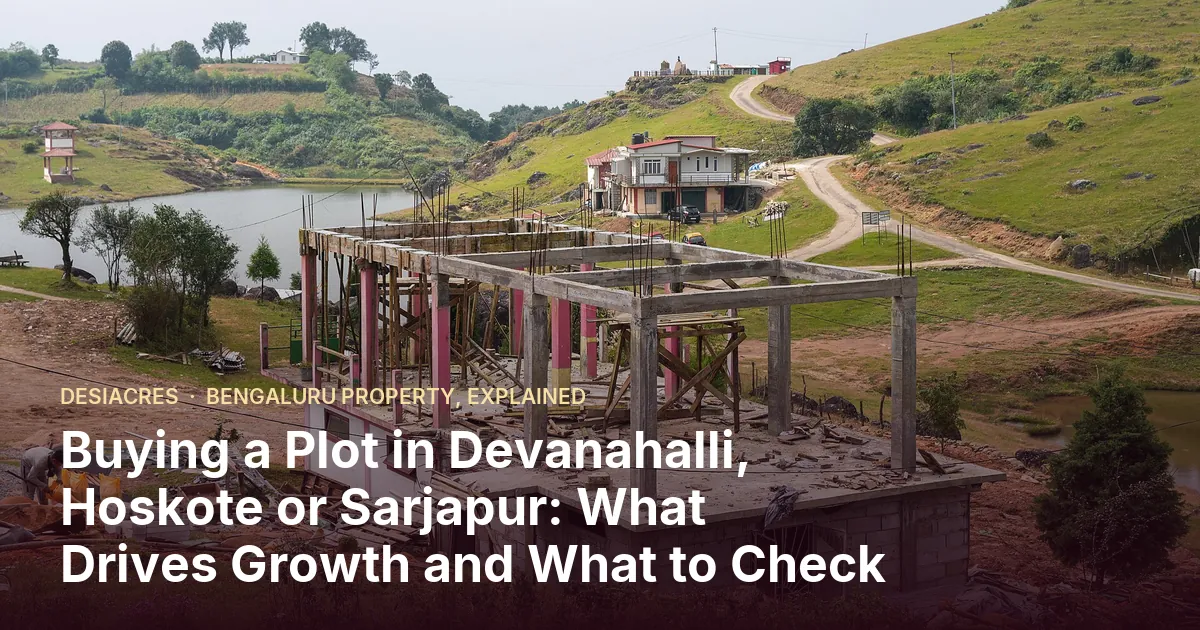
- Devanahalli, Hoskote and Sarjapur draw plot buyers for different reasons: air and industry, highways and the east, and the Sarjapur Road and Hosur corridor. A reason is not a return. Treat every growth story as a hypothesis to test, not a fact to pay for.
- On the edges of Bengaluru the same road can pass through three authorities and four kinds of land. Approval, conversion and the record of rights decide whether a plot is a home site or a dispute.
- Run the screens first and pay legal fees second: planning authority, layout approval, conversion, khata type, drains and lakes, road access. A plot that fails any of these is cheaper to leave than to fix.
- This guide quotes no prices and no growth rates, because none can be responsibly promised. Use it as a checklist and a way to think. It is not investment, legal or tax advice.
Ask ten people where to buy a plot around Bengaluru and three names come up again and again: Devanahalli, Hoskote and Sarjapur. They sit at three different edges of the city and they grow for three different reasons. They also share the same traps: layouts that look legal and are not, land that is cheap because it floods, and promises about a road or a metro that has not been built.
This guide does not tell you which one to buy, and it does not quote prices or growth percentages, because we do not think anyone can promise them. It does three things. It explains the reasons buyers look at each place. It gives you the checks that apply on the city's edge, where several authorities and kinds of land meet. And it shows how to turn a story you heard into something you can test. For the general approach to plots, read our guides on plot approvals, what you can build and the papers to check and plot or apartment.
Why buyers look at each place
Devanahalli and the north-east
Devanahalli is known for the airport and the roads, rail and business activity that gather around an airport. Buyers also point to industrial and aerospace parks, the highway links to the city and the idea of a future town around the airport. These are real features of the area. What is uncertain is when, how much and for whom. A proposed transit link, a planned town or a promised park is a plan, and plans change.
What to do with the story: find the official notification or project page for any scheme that is part of the pitch, and write down what stage it is at (proposed, approved, funded, under construction, open). Only the last two have any dependable effect on a plot's usefulness.
Hoskote and the east
Hoskote sits on the highway corridor to the east and has attracted warehousing, logistics and manufacturing along with housing. Buyers like the connection to the main roads and the proximity to the city's eastern employment belts. The area also has many lakes and tanks, and agricultural land with complicated records, so the checks on land use, records and water bodies matter more here than the pitch.
What to do with the story: separate land that sits on or next to the main roads from land reached by a village road that you cannot confirm. The first has a clear access and the second often depends on a neighbour's goodwill.
Sarjapur and the south-east
Sarjapur is known for the road of the same name, the technology and residential belts around it, and its closeness to the outer ring road side of the city. It is also an area where growth has run ahead of drainage and roads in some pockets, with low ground and lakes that need respect. See our Sarjapur corridor note for a longer view, and the water map for the supply side.
What to do with the story: treat any plot near a lake, a stream or a low patch as a case for the drain and flood checks first and the price second. Our guide to buying near a lake and the drain buffer screening guide are written for this.
The growth drivers to look for, and how to test them
When someone tells you a place will grow, ask which of these drivers they mean, and whether each has evidence you can see.
| Driver | What it can do | How to test it | |
|---|---|---|
| Jobs nearby | Brings tenants and buyers | Look for operating employers and offices, not announced ones | |
| Roads and highways | Cuts travel time | Check that the road is built and open, and its real width | |
| Metro, suburban rail | Makes a place reachable without a car | Find the official status and date, and the station's distance on foot | |
| Airport and logistics | Creates jobs and demand for housing | Check the actual activity and the roads that serve it | |
| Social infrastructure | Schools, hospitals, shops make a place liveable | Visit on a weekday and count what is open | |
| Water and power | Makes a layout habitable | Ask the layout, the bore and the tanker position; see [water checks](/blog/water-checks-before-buying-apartment-bangalore/) | |
| Supply of plots | Too many layouts cap price growth | Count active layouts and unsold plots on the ground | |
Our neighbourhood method goes through the same drivers for any area, and the areas pages show the data we track by locality. The 3D city map lets you see roads, lakes, drains and project sites around a plot before you visit.
The checks that decide whether a plot is buyable
These are in the order we would run them, cheapest first.
1. Which authority and which layout
On the edge of the city, a plot may fall under the metropolitan planning authority, a regional authority, a town body or a village panchayat, depending on where the boundary runs. The approvals and the khata or property record differ with each. Ask for the layout approval and the authority's name in writing, and compare it with what the map says. The Layout Legit Meter takes you through a layout's approval chain, from land conversion to the release order, and gives a grade and the papers to ask for.
2. Land conversion and land use
Agricultural land must be converted for non-farm use through the process the law provides, and the records must show it. A plot sold from land that is still recorded as agricultural is a classic problem on the outskirts. Ask for the conversion order, check it covers the whole layout and not a part, and check its conditions were met. See our land verification guide and the RTC and mutation guide.
3. The record of rights
The RTC, the mutation history and the survey sketch tell you who the revenue records say owns the land and whether any tenant, loan or notice is attached. Compare the survey number on the sketch, the RTC and the deed. A mismatch must be explained before you pay.
4. Khata, or its village equivalent
A plot inside a city or town authority usually has a khata. In a village panchayat area, the property record may be an e-Swathu or an equivalent entry. Banks and buyers care about which one you can show. A plot with no clean record may be impossible to finance or to sell later. See E-Khata in Bangalore for the city side.
5. Access, in writing
A plot must reach a road you are entitled to use. Ask for the layout's internal road widths and for the public road the layout connects to, and look for any gap between the two. A beautiful layout with no legal link to a public road is a trap, and it happens on the outskirts.
6. Water bodies, drains and low ground
Many outer areas have lakes, tanks and storm-water drains, some missing from older maps. Screen the plot against drains and lakes, then walk it after rain. Our GeoVerify checks cover the revenue village, lakes, drains, flood signs and road access for a pin you drop, as a first filter before the legal work.
7. What you can build
A plot's size and the width of the road decide how much can be built, with setbacks, coverage and height limits set by the rules that apply. Use PlotMax to see the largest home your plot size and road width can hold, and treat the answer as a starting point to be confirmed with an architect and the authority.
Reading the pitch
Salespeople on the outskirts use a small set of lines. Here is how to translate them.
- "The airport is coming up here." The airport is already built. Ask what specifically is changing near this plot, and by when.
- "Metro is coming." Ask for the official status and the station location. A proposal is not a line.
- "Prices have doubled." Ask for dated sale records of plots of the same size in the same layout. Do not accept a number without a source.
- "Only a few plots left." Ask for the sold, available and held list with plot numbers and dates.
- "Approved layout." Ask which authority, the approval number, the date and the release order.
- "Clear title." Ask for the title chain and a written opinion from an advocate you chose.
- "Ready to build." Ask for water, power and the internal road status, in writing.
A simple order of work
- 1Pick the corridor for a reason you can write in one sentence, and list the evidence.
- 2Drop a pin on the plot in the 3D map and read what is around it.
- 3Check the approval chain with the Layout Legit Meter.
- 4Run the papers: conversion, RTC, mutation, EC, khata or village record.
- 5Visit twice, once on a weekday and once after rain if you can.
- 6Compare with two other layouts nearby, on the same checklist.
- 7Only then negotiate, and only with a title opinion in hand.
If you are comparing a plot with a flat, the plot or apartment guide sets out the trade-offs.
Frequently Asked Questions
Is Devanahalli a good place to buy a plot?
It has genuine features, including the airport, industrial parks and highways, and buyers have been interested in it for years. Whether a particular plot is a good buy depends on its approval, records, access and price, so check the papers and the plan status before you pay.
What is the biggest risk when buying a plot near Hoskote?
Land use and records. The area has agricultural land, many lakes and tanks, and layouts of mixed quality. Check conversion, the layout approval, the survey records and the water-body screens before you commit.
Are plots in Sarjapur at risk of flooding?
Some low-lying pockets and plots near lakes and drains can be. Screen each plot against drains, lakes and flood signs, walk it after rain and ask neighbours. Do not rely on the area's name.
Can I get a home loan on a plot at the edge of the city?
Banks usually lend on plots in approved layouts with clean title and the right khata or property record. A plot without these may not be financeable. See our home loan guide for how lenders think.
Want a plot screened before you pay?
DesiAcres' land desk can screen a plot for approvals, records and ground risks, and coordinate the advocate's title opinion. WhatsApp +91 79756 19031 or call +91 94296 93951, or begin with the Layout Legit Meter.
- DesiAcres, Plots and land in Bangalore (desiacres.com)
- DesiAcres, Layout Legit Meter (desiacres.com)
- Bhoomi, Government of Karnataka (landrecords.karnataka.gov.in)
Written by DesiAcres Editorial at DesiAcres Advisory Group, a Bengaluru buyer-side property advisory. General information, not legal or investment advice.
Run it through the free 15-point check, price vs comparables, red flags and a clear verdict.
Check a property →