
Property Registration in Karnataka: The Kaveri Process, Step by Step
How a sale deed gets registered in Karnataka: Kaveri Online, e-stamp, documents, witnesses and biometrics at the sub-registrar, and what to do right after.
DesiAcres Editorial · 19 November 2026 · Updated 19 November 2026 · 9 min read
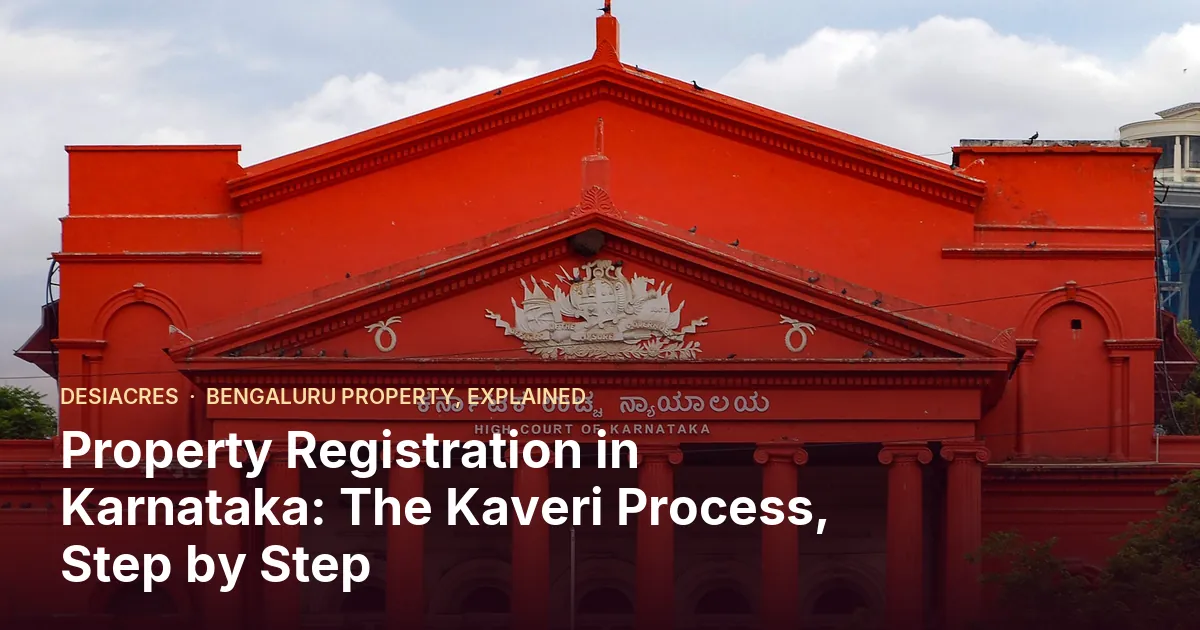
- Registration is the step that turns an agreement into ownership on the public record. It is short on the day, but it depends on days of preparation: the deed, the stamp duty, the identity papers and the appointment.
- Everything is built around Kaveri Online: the deed details, the stamp duty and registration fee, the appointment and the sub-registrar's record. A mistake in the deed is far harder to fix after registration than before.
- After registration you are not done. The khata and the revenue records still have to be changed into your name, and the bank, the builder and the electricity and water connections need the new papers.
- This is general guidance, not legal advice. Fees, forms and procedures are revised from time to time, so confirm them with the sub-registrar's office or your advocate.
Registration is the step that makes a sale deed count in law. In Karnataka, a sale is not complete until the deed is registered at the sub-registrar's office with stamp duty and the registration fee paid. Many buyers leave it to the builder's or seller's agent, then find years later that a name was misspelt or a schedule was wrong.
This guide walks through the registration of a sale deed for a flat, a plot or a house in Bengaluru, in the order it actually happens. It covers what to prepare, how the Kaveri system fits in, what happens on the day, and the follow-up that buyers forget. For the money side, our stamp duty guide and real cost of buying explain how the totals are built.
What registration actually does
Registration does three things. It puts the deed on the public record, so anyone who searches the property later can see the sale. It fixes the date from which the ownership change is formally recorded. And it creates the entry that will appear in the encumbrance certificate. That last point is why it matters so much for the next buyer, the next bank and your own heirs. See how to read these papers in our land verification guide.
Registration does not, by itself, clear title. If the seller never had a clean right to sell, a registered deed does not create one. That is why the checks before the deed, from the resale paper checklist to the RTC and mutation reading, come first.
Before you go: the preparation
1. The deed itself
The sale deed is drafted by an advocate or by the builder's legal team. Before it is printed on stamp paper, read it line by line. Check these every time:
- Names of all sellers and buyers exactly as they appear on identity papers, including initials and spelling.
- The property description, which must match the title papers: survey number, hissa, khata or property identification number, extent, boundaries, and for an apartment the unit number, floor, built-up and carpet area and the share of land.
- The sale consideration, and how it was paid. It must match the payments you actually made, through banks, with receipts.
- References to earlier documents: the title chain, the agreement to sell, the loan and any releases.
- The seller's declarations about encumbrances, litigation and approvals.
- For an apartment, the references to the approved plan, the project registration number and the occupancy certificate where relevant.
A wrong boundary or a mistyped survey number can be corrected only by another deed, with more cost, so ask for the draft a few days early.
2. Stamp duty and registration fee
Stamp duty in Karnataka is paid on the higher of the agreed price and the government's guidance value, with the rate set by law and revised from time to time, and with cess and a separate registration fee. Our stamp duty guide shows how a total is built and what to ask a seller. We do not repeat rates here because they change, and the page you rely on should be dated.
Stamp duty is paid online, usually through the e-stamp or e-payment route linked to the Kaveri process, and you receive a certificate or challan with a reference number that goes into the deed. Keep it safe, and check its details against the deed, because a mismatch holds up the appointment.
3. Documents to carry
Each registration office has its own checklist, and your advocate will confirm it, but the usual set is:
- Original identity and address proof of every buyer and seller, with PAN. Aadhaar-based identification is commonly used for the biometric step.
- Passport-size photographs.
- The e-stamp or payment proof and the printed deed.
- Original and copy of the previous title documents: the last sale deed and earlier deeds in the chain.
- The latest khata and tax paid receipt, and the encumbrance certificate.
- For a loan-funded purchase, the bank's representative and the bank's documents.
- For a company, trust or an HUF seller, the board resolution or authority papers.
- For an NRI or OCI party, a valid passport and visa or OCI documents. If someone signs on a power of attorney, the registered power of attorney and the holder's identity.
- Two witnesses with identity proof, as required by the office.
Test your list with the sample land papers so you know what a typical set looks like before you gather your own.
The Kaveri process in order
The department's Kaveri Online system handles most of the work. The steps below are the sequence buyers meet; screens and labels change, so rely on the on-screen instructions and your advocate.
- 1Enter the deed details. The deed's data, parties and property description are entered on Kaveri Online, so the fee and duty can be computed.
- 2Pay the duty and fee. The stamp duty and the registration fee are paid, and the payment reference is linked to the deed.
- 3Book the appointment. You choose a date and time slot at the sub-registrar's office that has jurisdiction over the property. A flat in a project that spans areas needs the right office, so confirm the jurisdiction with your advocate.
- 4Upload or submit the documents. Scanned copies of the deed and identity papers are uploaded as asked, and the printed set is carried on the day.
- 5Attend the appointment. Buyers, sellers and witnesses go to the office at the booked time.
- 6Verification and biometrics. The sub-registrar's staff check identity, and fingerprints and photographs are captured.
- 7Signing and registration. The deed is signed in front of the registering officer, each party is identified, and the deed is registered.
- 8Receipt of the registered deed. You are given an acknowledgement, and the registered original is returned after scanning, usually a few days later through the office's process.
If any party cannot attend, a properly executed and registered power of attorney can sometimes be used, but many offices and banks look at it closely. It is far smoother if every party attends.
On the day: what to watch
- Arrive on time with everyone, including both witnesses. A missing party sends you to the back of the queue or a fresh slot.
- Check the printed deed one last time against the identity papers. A last-minute spelling error is cheaper to fix before signing.
- Carry the originals the office asked for. A scan is not a substitute.
- Do not pay anything to anyone outside the official payment channels, and keep receipts for any official fee.
- Ask for the acknowledgement and the registration number on the spot, and photograph it.
After registration: the work that remains
Registration is not the end. The next steps are what turn a registered deed into a smooth ownership.
- 1Khata change. Apply to have the khata changed to your name, so that the municipal and tax records follow. For a flat, our E-Khata guide explains what to apply for and what to check.
- 2Revenue record change. For land, the revenue records (the RTC and mutation) must be changed into your name. Read how in our RTC and mutation guide.
- 3Update the loan and bank records. The bank will hold the original deed or a copy, and the loan documents must show the registered details.
- 4Utility connections. Electricity and water accounts, and in a society the maintenance records, should be changed to your name. See after-possession costs and the owners' association.
- 5Safe custody. Keep the registered deed, the e-stamp proof, the encumbrance certificate and the khata together, with scanned copies stored in two places.
- 6Take a fresh encumbrance certificate. After a few weeks, take a new EC to confirm your sale appears correctly. It is the quickest check that the record is right.
Common registration problems and how to avoid them
| Problem | Why it happens | How to avoid it | |
|---|---|---|
| Name or number mismatch | Deed typed from an old document | Check against identity and title papers before printing | |
| Stamp duty shortfall | Guidance value not checked | Compute duty on the higher of price and guidance value | |
| Missing document on the day | Checklist not confirmed | Ask your advocate for the office's list | |
| Wrong sub-registrar | Jurisdiction not checked | Confirm before booking the slot | |
| Party absent | Late travel or illness | Plan a registered power of attorney early or reschedule | |
| Loan not ready | Bank's disbursal timing | Align the bank's date with the registration slot | |
| Wrong schedule | Copying an older deed | Compare with the survey sketch and approved plan | |
Frequently Asked Questions
Is it compulsory to register a sale deed in Karnataka?
Yes. A sale of immovable property above a very small value must be registered to be legally complete, and the deed must be registered at the sub-registrar's office with stamp duty and the registration fee paid.
Can I register a property without visiting the sub-registrar?
Generally no. The parties are expected to appear for identification and biometrics, though a properly executed, registered power of attorney can sometimes be used. Many offices and banks examine such a power closely, so it is smoother if you attend.
How long does registration take?
The visit itself is usually short. The time depends on the preparation before it: the deed, the stamp duty and the appointment. Allow time for the registered original to be returned after scanning, and plan the khata change straight after.
What should I do after the deed is registered?
Apply for the khata change, update the revenue records for land, give the registered papers to your bank, change the utility accounts to your name, store the originals safely, and take a fresh encumbrance certificate a few weeks later to confirm the entry.
Need the paperwork run properly?
DesiAcres' legal desk can review your draft deed, check the stamp duty and coordinate the registration and the khata follow-up with a property advocate. WhatsApp +91 79756 19031 or call +91 94296 93951, or see the legal services page.
- Kaveri Online, Department of Stamps and Registration, Karnataka (kaverionline.karnataka.gov.in)
- DesiAcres, Stamp duty in Karnataka (desiacres.com)
- DesiAcres, The real cost of buying a home in Karnataka (desiacres.com)
Written by DesiAcres Editorial at DesiAcres Advisory Group, a Bengaluru buyer-side property advisory. General information, not legal or investment advice.
Run it through the free 15-point check, price vs comparables, red flags and a clear verdict.
Check a property →