
Buying a Resale Flat in Bangalore: The Owner's Paper Checklist
A step-by-step checklist for buying a resale flat in Bangalore: the papers to see, the dues to clear, the TDS to deduct and the order in which to pay.
DesiAcres Editorial · 17 November 2026 · 7 min read
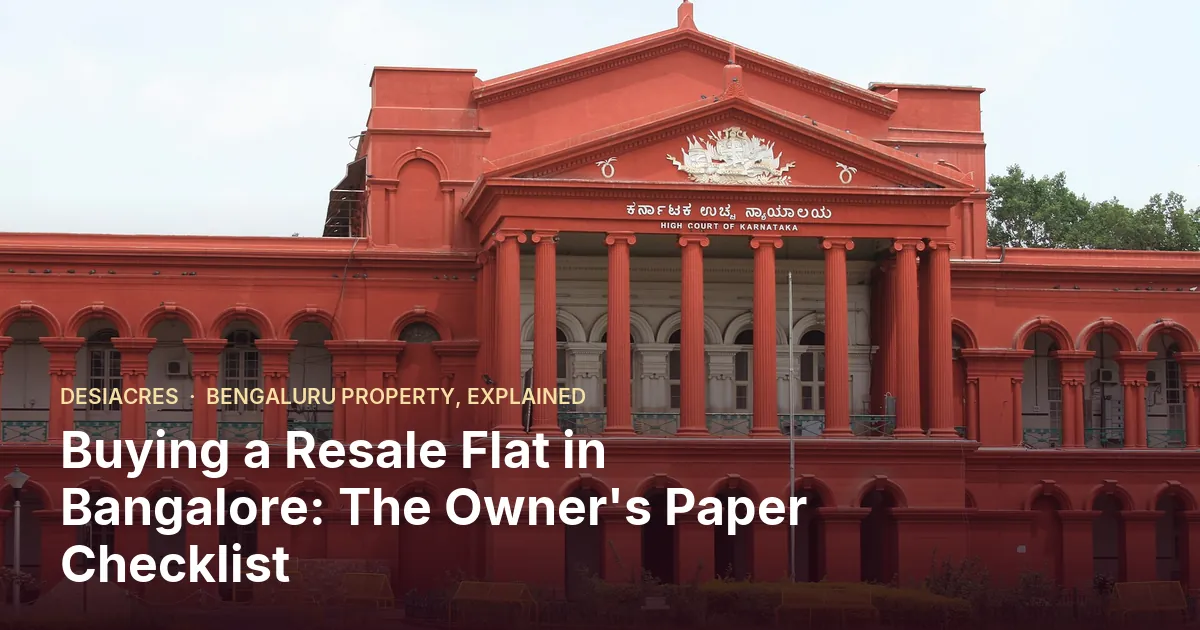
- With a resale flat you are buying a history. The papers show whether that history is clean.
- See the documents before you pay any token money, and have a lawyer read the chain of title, not just the last deed.
- Match the seller's name, the flat number and the area across every paper. Differences are the usual first sign of trouble.
- Deduct TDS where the law requires it, clear all dues before registration and pay the balance only when the deed is signed.
A resale flat has real advantages: you can see it, the building has an owners' association, the water and the neighbours are known and you can usually move in quickly. It also has a history. The seller's papers tell you whether the flat is truly the seller's to sell, whether anyone else has a claim on it and whether the building itself is in order.
This checklist takes you through the papers in the order you will meet them.
Before anything else: ask for the papers
Do not pay a token amount before you have seen the basic documents. Ask the seller for copies of the following, and keep a record of the date you saw each.
- 1The registered sale deed in the seller's name.
- 2The earlier deeds that make up the chain of title, going back as far as the records go, usually thirty years or more.
- 3The khata certificate and khata extract, preferably the e-khata. See our e-khata guide.
- 4Property tax receipts for recent years.
- 5The encumbrance certificate for a long period.
- 6The approved building plan and the occupancy and completion certificates.
- 7The latest electricity and water bills.
- 8A letter from the owners' association about dues and any pending issues.
- 9Identity proofs of all owners and of anyone who signs.
What each document tells you
| Document | What it proves | What to look for |
|---|---|---|
| Sale deed | The seller bought the flat and how | Names, flat number, built-up area, boundaries and the deed's registration number |
| Chain of earlier deeds | Each past transfer was valid | Gaps, unregistered transfers, missing links, gifts or wills without proof |
| Khata certificate and extract | Who the city treats as the owner for tax | A or B status, the same name and area as the deed |
| Encumbrance certificate | Registered transactions and loans on the property | Mortgages, attachments, unknown sales, any entry you were not told about |
| Tax receipts | Whether the tax is paid | Unpaid years that become your liability |
| Approved plan and certificates | The building was legally built | Deviations, extra floors, no occupancy certificate |
| Utility bills | The supply is live and in whose name | Dues, disconnections, unpaid arrears |
| Association letter | There are no dues or disputes | Pending maintenance, corpus issues, legal cases |
Check the title properly
The title check is the heart of the process. A flat may have been sold more than once, may be part of an inheritance with several heirs, or may have been built on land with a defect in its own history.
- Read the chain. Each deed should show the seller having a right to sell. A gap between two deeds needs an explanation.
- Check how it was acquired. Purchase, gift, partition, will and inheritance each need different supporting papers.
- Check all co-owners. Every owner or heir must sign, or the sale can be challenged. If a co-owner is a minor or abroad, ask your lawyer.
- Check the land share. For a flat, the buyer gets an undivided share of the land. The deed should state it.
- Check any litigation. Ask your lawyer to search court records for the seller, the builder and the property.
You can use AlphaScan to read a deed, an encumbrance certificate, an RTC and a khata, and it flags mismatches. It is a first read, and a lawyer's opinion is still the one that counts.
Loans and mortgages on the flat
If the seller has a home loan on the flat, the bank holds the original documents. That is common and not a problem if handled properly.
- 1Ask for a loan statement showing the outstanding amount.
- 2Agree that the buyer's payment will be sent first to the bank to clear the loan, with a letter from the bank.
- 3Collect the original documents from the bank only against payment, or arrange a direct transfer if you are taking a loan from the same or another bank.
- 4Make sure the bank issues a no-dues letter and that the encumbrance record is updated.
The building must be in order, too
You are buying a flat in a building. Ask about:
- The occupancy certificate and the completion certificate. A building without them can face action and loan refusals.
- The owners' association and its accounts. See the first year after possession.
- Maintenance and corpus dues. The association will give a no-dues certificate, and you should get it before you register.
- Structural or water problems the association already knows about.
- Pending special assessments, such as a levy for repairs.
The price check
A resale price is whatever two people agree, but you can test it. Compare it with recent sales and listings of similar flats in the same building and nearby. Use the Resale price check to compare an asking price with the record, and the Negotiation Coach to set a target. Our guide to listing prices versus builder prices explains why asking prices run ahead of what flats actually sell for.
TDS and the taxes on a resale purchase
If the sale value is above the limit set in the income tax law, the buyer usually has to deduct a small percentage as tax at source and deposit it with the government, then give the seller proof. For a resident seller this is a one percent deduction on the sale value, above the threshold, under Section 194-IA. A non-resident seller is covered by different and much stricter rules, and your adviser should handle it.
Do not skip it. A buyer who fails to deduct and deposit can face interest and penalty. Your chartered accountant or the bank can help with the forms and the timing.
On the cost side, plan for stamp duty and registration at the sub-registrar, as set out in our stamp duty guide, and for the hidden costs that buyers forget.
The order of a clean transaction
- 1Shortlist and inspect. Use the site visit checklist.
- 2Ask for documents and get a lawyer to read them.
- 3Run the location check on GeoVerify and look up the builder.
- 4Agree the price, and write down what is included, such as fittings and parking.
- 5Sign a sale agreement with a small advance and a clear timeline, if the lawyer is satisfied.
- 6Clear loans and dues with proof.
- 7Deduct and deposit the TDS as required.
- 8Register the sale deed at the sub-registrar and pay the duty.
- 9Pay the balance against the registered deed and the keys.
- 10Transfer the khata, the utilities and the association records in your name.
Warning signs
- The seller will not share the chain of deeds.
- The flat number or the area differs between documents.
- The seller is in a hurry and asks for cash.
- The seller is not the person on the deed, and has only a power of attorney.
- The building has no occupancy certificate.
- The price is much below the market with no reason given.
- The seller refuses a lawyer's review.
Any one of these is reason to pause. Several together are reason to walk away.
Frequently Asked Questions
Which documents should I check when buying a resale flat in Bangalore?
The registered sale deed, the chain of earlier deeds, the khata certificate and extract, the encumbrance certificate, tax receipts, the approved plan with occupancy and completion certificates, utility bills and an owners' association letter.
What is an encumbrance certificate and where do I get it?
It lists registered transactions on a property for a period, including mortgages. It is available through the state's registration portal.
Do I need to deduct TDS when buying a resale flat?
For a resident seller and a sale value above the threshold in the law, the buyer generally deducts one percent under Section 194-IA and deposits it. Rules for non-resident sellers differ, so ask a tax adviser.
Can I buy a flat that has an existing home loan?
Yes, if the loan is cleared as part of the transaction, with the bank's no-dues letter and the original documents handed over on payment.
How long does a resale purchase take?
Often several weeks to a few months, depending on the loan, the documents and the registration slot. Rushing is a bigger risk than a short delay.
- Kaveri Online Services, Karnataka (kaverionline.karnataka.gov.in)
- Income Tax Department, Section 194-IA (incometax.gov.in)
- Karnataka RERA (rera.karnataka.gov.in)
Written by DesiAcres Editorial at DesiAcres Advisory Group, a Bengaluru buyer-side property advisory. General information, not legal or investment advice.
Run it through the free 15-point check, price vs comparables, red flags and a clear verdict.
Check a property →