
The Real Cost of Buying a Home in Karnataka: Everything Beyond the Price
The price on the brochure is not what you pay. See the stamp duty, registration, GST, deposits and other costs to budget for in Karnataka.
DesiAcres Editorial · 13 November 2026 · 4 min read
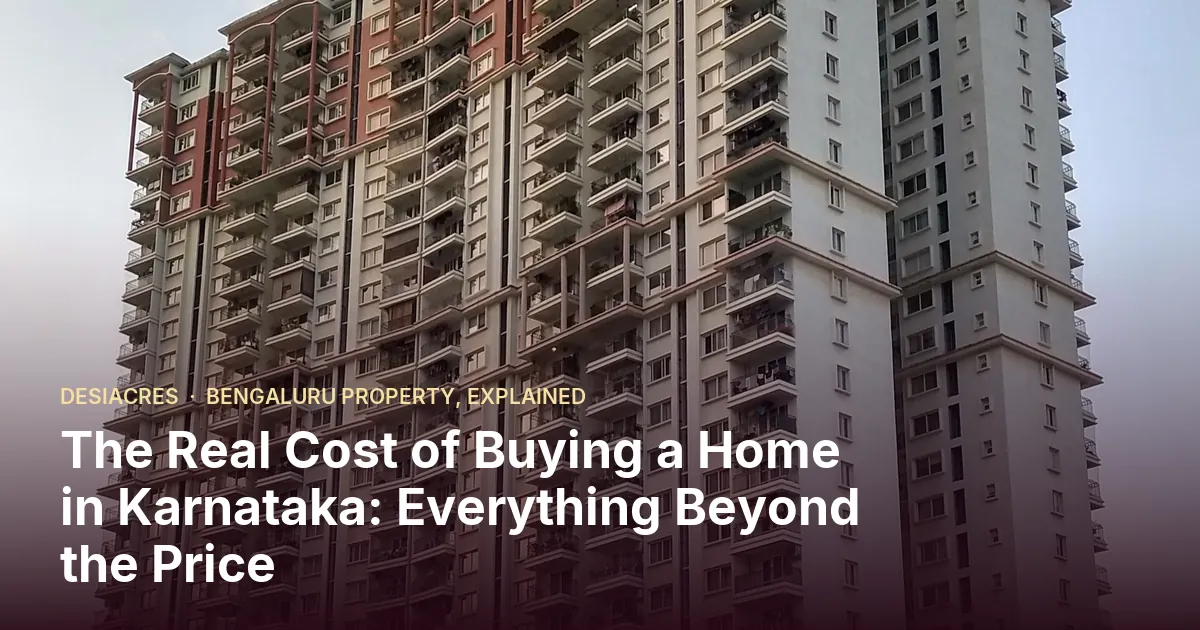
You found a flat you like and the price is within budget. Then the sales executive sends the cost sheet.
Suddenly the number is far larger than the one on the brochure.
This surprise happens to buyers every month, and almost all of it is avoidable if you know the list in advance.
Why the brochure price is only the start
A brochure price is usually the base price for the apartment. A buyer then adds taxes, government fees and the builder's extras. Together these can add a meaningful share on top of the base price.
Because the exact rates and slabs can change, always confirm today's figures with the registration office or your lawyer. Our stamp duty calculator for Karnataka works out the main government costs and the extras together.
The government costs
Stamp duty
Stamp duty is a state tax paid on the sale deed. It is calculated on the higher of the agreement value and the guidance value for the property, and it varies with the price of the property. Check the current slab before you finalise the budget.
Registration fee
Registration is a separate, smaller charge paid when the sale deed is registered at the sub-registrar's office.
GST on under-construction homes
Under-construction homes attract GST, with a lower rate for the affordable-housing category and a higher rate for the rest. Ready homes with an occupancy certificate and resale homes carry no GST on the sale. This is why two flats at the same price can cost very differently.
The builder's extras
Many cost sheets carry charges that are not part of the base price. Ask for each of these in writing:
- Car parking. Often priced separately, and sometimes per slot.
- Clubhouse and amenities charge. A one-time fee in many projects.
- Maintenance deposit. Usually collected in advance for a number of months, and sometimes years.
- Sinking or corpus fund. A reserve for future repairs, collected once.
- Legal, documentation and khata charges. Charged by the builder or their lawyer.
- Electricity, water and gas connection fees.
- Floor rise charges. Higher floors cost more per square foot in many projects.
- Preferential location charges. For park-facing or corner units.
None of these are illegal. They only become a problem when they are discovered late.
The loan costs
If you borrow, add:
- Processing fee
- Legal and technical valuation fees charged by the bank
- Insurance linked to the loan, if you choose it
Ask whether the bank charges anything for part-prepayment or foreclosure. For floating-rate home loans taken by individuals, the rules generally do not allow a prepayment penalty, but confirm this in your own loan terms.
The cost of moving in
People forget this part of the budget:
- Interiors, modular kitchen and wardrobes
- Curtains, lights, fans and appliances if not included
- Shifting and packing
- Brokerage, if you used a broker for a resale purchase
Interiors alone can be a large fraction of a flat's price if you want a full finish.
The cost of waiting
If you are buying under construction, you may pay rent and EMI at the same time while the project is built. A delayed handover makes this longer. Our delay risk radar shows how a builder's record compares with the promise.
A worked way to build your own number
Take a clean sheet and add these in order:
1. Agreement value from the builder's cost sheet
2. Stamp duty and registration for your price band
3. GST, if the home is under construction and not affordable-category
4. Parking, clubhouse, deposit and corpus fund
5. Loan processing and legal charges
6. Interiors and moving
7. A buffer of a few percent for the things you did not think of
Then compare the final number with your savings and the loan the bank will actually sanction. Our total cost calculator does steps 1 to 5 for you.
Three habits that protect you
- Ask for the full cost sheet before you pay a token. If you receive only a headline price, ask again.
- Compare cost sheets between projects, not brochure prices. The cheaper-looking project often is not, once extras are added.
- Read every line before you sign the agreement for sale. Charges that are not in the agreement are hard to argue about later.
The one line to remember
Do not ask "what is the price?". Ask "what is the total amount I will have paid when I get the keys?".
When you have that number in writing, you can compare homes fairly.
- Karnataka Department of Stamps and Registration (kaverionline.karnataka.gov.in)
- Karnataka RERA (rera.karnataka.gov.in)
Written by DesiAcres Editorial at DesiAcres Advisory Group, a Bengaluru buyer-side property advisory. General information, not legal or investment advice.
Run it through the free 15-point check, price vs comparables, red flags and a clear verdict.
Check a property →