
How to Choose the Right Locality in Bangalore: A 7-Step Method
Skip "best areas" lists. A 7-step method to choose a Bangalore locality using commute, water, flood, builder, price and daily life, with tools for each step.
DesiAcres Editorial · 17 November 2026 · 6 min read

- There is no best area in Bangalore, only the best area for your commute, budget, family and risk.
- Start with the commute at your real hours, because it decides how your days feel more than any amenity.
- Check the unglamorous things in each locality: water, floods, roads and the planning authority, before price and amenities.
- Narrow to two or three localities, visit each at different times and let the data and your visits agree before you commit.
Every "best areas to buy in Bangalore" list is out of date by the time it is published, and most are written for an imaginary buyer. They ignore your office, your parents, your school and your budget.
What works better is a method. This post gives you seven steps that take you from a long list of areas to a short list of two or three, with a reason for each choice.
Step 1: Write down what you cannot compromise on
Before you look at a map, write a short list of non-negotiables. A family has about five.
- The commute of the main earners, in minutes at real hours.
- The school or the school types needed in the next ten years.
- The budget, including a safe EMI. See the affordability tool.
- The household: parents, children, pets, a vehicle or two.
- The type of home: flat, villa or plot, and the size.
This list is your filter. Any locality that fails it is out, whatever its reputation.
Step 2: Test the commute at the real time
A map gives the distance. Your day gives the time. A route of 12 km can take 25 minutes at 6 am and 90 minutes at 9 am.
- Pick the exact office or offices and the real hours of leaving and returning.
- Test the route on a weekday, at those hours, in both directions.
- Count the pinch points: signals, junctions, level crossings, flyovers under repair.
- Ask whether the metro, a bus or a company shuttle offers a better way.
The Commute Finder lists homes by door-to-door time to your workplace. Our post on metro Phase 3 shows how to think about a future line without paying for the promise.
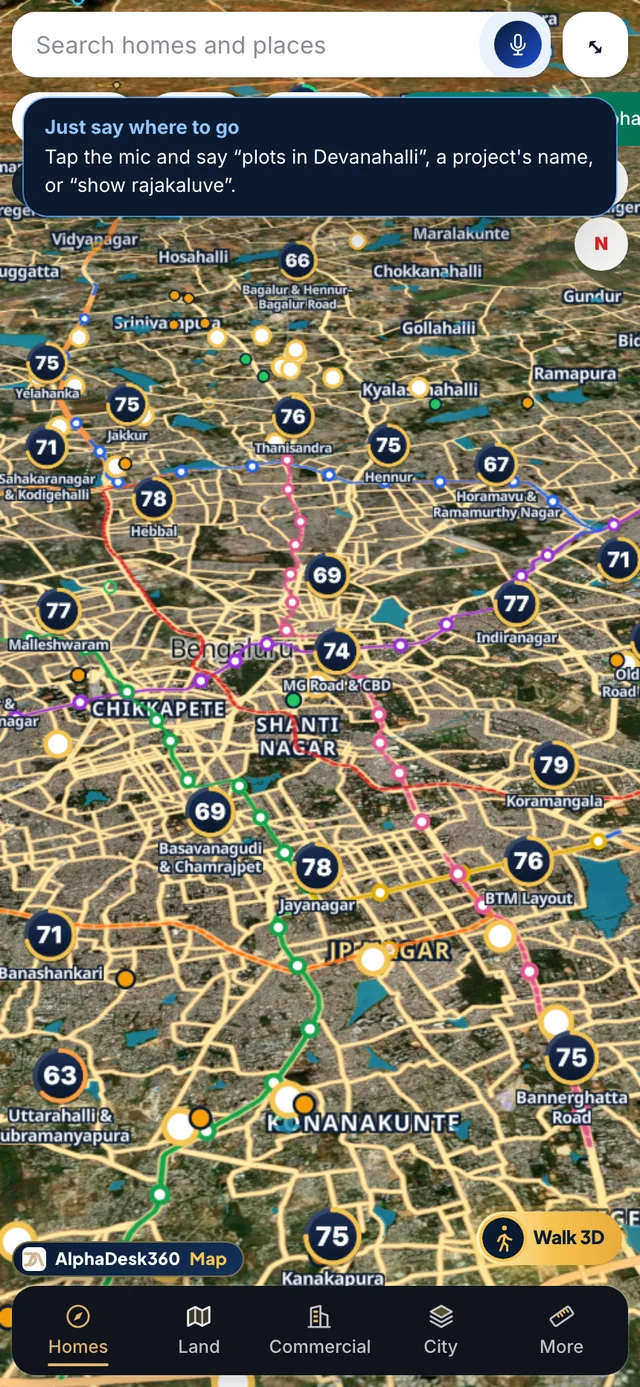
Step 3: Check the ground, not just the brochure
Two localities with equal commutes can be very different in risk.
- Flood and lake exposure. Which parts flood, and where does the water go? See buying near a lake.
- Water supply. Piped, borewell or tanker? See the water checks.
- Roads. Width, condition and whether the approach road is a public road.
- Surroundings. Waste sites, sewage plants, burial grounds and railway lines nearby.
GeoVerify screens these for any pin. What's near shows the daily-life places around a spot, and the Zones and wards lookup tells you which authority governs it.
Step 4: Understand what is planned
An area changes over the years you will own the home. The question is how.
- Is there a metro line, a road widening or a flyover planned, and what is the evidence?
- Are there large layouts or townships being developed nearby that will add traffic and demand?
- Is any part of the land marked for a road, a park or an acquisition?
Plans can help or hurt, and they take longer than announced. Treat them as a variable, and ask whether your decision still works if they come late.
Step 5: Look at the price properly
Pricing in the same locality can vary by a lot, and the same price can mean different things.
- Compare the price per square foot of carpet area, not super built-up area. See how to read a cost sheet.
- Compare like with like: age, builder, size and floor.
- Look at the price trend in the area, not only one project's launch price. The Market dashboard and the Price Book show published figures with sources and dates.
- Ask what a seller of the same flat will get when you sell it, because resale ease matters.
Step 6: Check the builder and the project
A good locality does not rescue a bad project.
- Check the RERA registration and the promised date. See reading a RERA page.
- Look at the builder's delivery history on the Delay Risk Radar.
- Compare projects in the shortlisted areas on the Compare page, and read the AlphaScore of each.
Step 7: Visit at different times
You are going to live there for years. Spend time in the area as a resident would.
- 1Go on a weekday morning and see the traffic and the school run.
- 2Go on a weekday evening and see how the roads and the pavements cope.
- 3Go on a weekend and see the noise, the crowd and the life.
- 4Walk the last kilometre to the shops, the school and the transport you plan to use.
- 5Talk to a shopkeeper, a security guard and a resident, and ask what they like and what they would change.
Use the site-visit scorecard and our site visit checklist to keep notes you can compare.
A scoring sheet you can copy
Give each locality a score from 1 to 5 on each row, weight the rows that matter most to you and compare totals.
| Factor | What to rate | Weight for you |
|---|---|---|
| Commute | Door-to-door time at real hours | High for most |
| Ground risk | Flood, lake, drain exposure | High |
| Water | Source and reliability | High |
| Daily life | Schools, hospitals, shops, parks within a short trip | Medium |
| Price | Fair price against like-for-like | High |
| Future | Planned roads, metro and growth, treated cautiously | Medium |
| Project quality | Builder, approvals, paperwork | High |
The sheet will not make the decision for you. It will show you where your instincts and the facts disagree, which is the useful part.
Common mistakes
- Choosing an area because a friend lives there.
- Paying for a metro or a road that is years away and uncertain.
- Ignoring the commute because the home is lovely.
- Comparing super built-up prices instead of carpet-area prices.
- Skipping the ground checks because the project looks premium.
- Visiting once, on a pleasant day.
Frequently Asked Questions
Which is the best area to buy a flat in Bangalore?
There is no single best area. The right one depends on your commute, budget, family needs and risk tolerance. Use the seven steps to compare two or three areas.
How do I check the commute from a locality?
Test the route at your real hours on a weekday, both ways, and use a tool such as the Commute Finder for door-to-door times to your office.
Should I buy near a planned metro station?
It can help over time, but metro projects run late and construction is disruptive. Pay a price that works even if the line opens later than planned.
How do I know if a locality floods?
Ask residents, check the road in heavy rain, and screen the location for lakes and drains with a tool like GeoVerify.
How many localities should I shortlist?
Two or three. Visit each at different times, compare the facts on a scoring sheet and then compare projects within them.
- Bengaluru Traffic Police (btp.karnataka.gov.in)
- Bangalore Metro Rail Corporation Limited (english.bmrc.co.in)
- Greater Bengaluru Authority (gba.karnataka.gov.in)
Written by DesiAcres Editorial at DesiAcres Advisory Group, a Bengaluru buyer-side property advisory. General information, not legal or investment advice.
Run it through the free 15-point check, price vs comparables, red flags and a clear verdict.
Check a property →