
Namma Metro Phase 3: What ORR West and Magadi Road Mean for Home Buyers
Phase 3 adds 44.65 km and 31 stations in West Bengaluru. What is official, what is a target, and how to check a home near the line before you pay.
DesiAcres Editorial · 17 November 2026 · 9 min read
- Phase 3 is two elevated corridors, 44.65 km in total with 31 stations, in West Bengaluru.
- JICA's stated completion target is January 2032. A target is not an opening date.
- A metro line raises demand around a station, but it does not fix a lake, a narrow road or a missing khata.
- Walk the last kilometre from the planned station to the home. That distance decides whether the metro helps you at all.
A metro announcement changes how people talk about a neighbourhood overnight. Brokers add "near metro" to every listing, and prices in the conversation move long before a single pillar stands. If you are looking at a home in West Bengaluru right now, this is the moment to slow down and separate what is officially planned from what is merely being said.
This guide lays out what Namma Metro Phase 3 is, what the official sources say about it, how to think about a home near either corridor, and the checks that matter more than the word "metro".
What Namma Metro Phase 3 actually is
Phase 3 is a set of two elevated corridors that together run for 44.65 km and have 31 stations. Both are in the western half of the city, an area that has had far less rail access than the east and the centre.
| Corridor | Runs between | Along | Character |
|---|---|---|---|
| ORR West | JP Nagar 4th Phase and Kempapura | The western Outer Ring Road | The longer corridor, links the south, the west and the north of the ring road |
| Magadi Road | Hosahalli and Kadabagere | Magadi Road | The shorter corridor, links the inner west to its outer edge |
The Outer Ring Road corridor is the longer of the two, at a little over 32 km. The Magadi Road corridor is about 12.5 km. Both are elevated, which matters for how the neighbourhood feels, and we come to that further down.
What is official and what is only a target
The central government's Cabinet approved Phase 3 in 2024, and the project is being financed with the help of Japan's international development agency, JICA. JICA's own project page states a completion target of January 2032.
Two words in that sentence deserve attention. The first is "target". Metro projects in India routinely run past their first stated dates because of land acquisition, utility shifting, tree and traffic permissions, and contract timing. The second is "completion", which is not the same as the day a station near you opens to passengers. Sections of a line often open in stages, so one stretch can open years before another.
For a buyer, the sensible approach is to plan around a range. If your decision only works if the line opens in 2032, you are betting on a schedule nobody controls. If it works even if the line opens in 2034, the metro is a bonus rather than the thesis.
How a metro line really changes property
The honest version of this story has three parts, and brokers usually tell only the first.
Before construction: expectation
The announcement itself moves sentiment. Enquiries rise, owners hold out for higher asking prices and some new launches add "metro" to their brochure. Much of this is hope, and hope is not priced the same way by every buyer.
During construction: friction
Elevated metro construction is loud, dusty and disruptive. Roads narrow behind barricades, diversions add time to your commute and the stretch directly under the viaduct can be unpleasant for a few years. If you plan to live in the home yourself, you will feel this phase far more than any future benefit.
After opening: access
Once a station works, the practical gain is real for people who can reach it easily. A home within a comfortable walk or a short feeder ride of a station gets a daily commute that is predictable and not tied to traffic. That predictability is what buyers and tenants eventually pay for.
Notice what is not on this list. Nothing in the metro itself fixes flooding, a narrow approach road, a poor builder record or an unclear title. It improves one dimension of a home, which is how you travel from it.
The "last kilometre" test
Most "near metro" claims fall apart on one measurement: the actual walking or riding distance from the home to the planned station, along real roads.
- 1Mark the planned station on a map and mark the home.
- 2Trace the route you would really walk or ride, including crossings, flyover ramps and any road with no pavement.
- 3Note the distance, then note how it feels at 8:30 in the morning and 7 in the evening.
- 4Ask whether the route crosses the Outer Ring Road or Magadi Road itself, because a main road with no safe crossing can turn a short distance into a long one.
- 5Compare that with the commute you make today, not with the straight-line distance on a brochure.
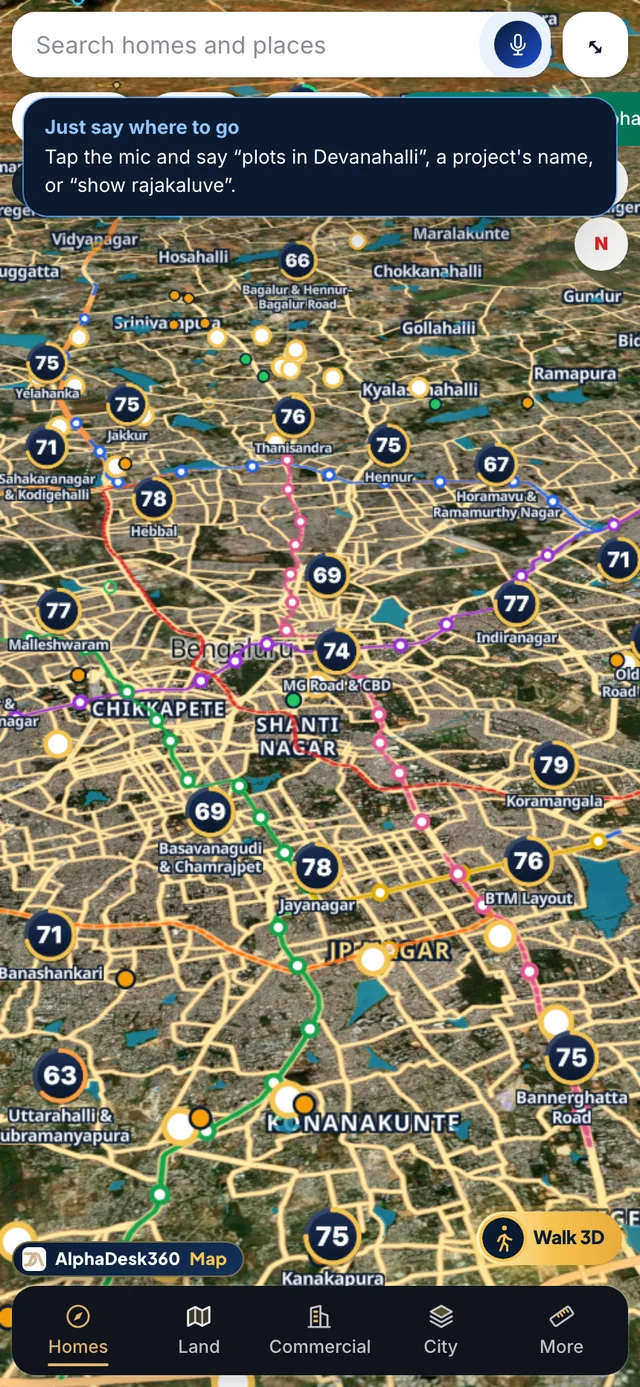
A home that is 800 metres in a straight line but 2 km by road is not an 800 metre home. You can run this exercise on the 3D map in DesiPropVERSE, and test door-to-door times to your own office with the Commute Finder.
What the metro does not change
Buyers near a new line often treat the metro as an all-purpose upgrade. It is better to keep a short list of things it leaves exactly as they were.
- Legal status of the land. An approved layout, an A khata and a clean title matter the same as before. Read our guide on e-khata and A khata.
- Flood and lake exposure. West Bengaluru has low-lying pockets, valley drains and lakes. A station does not move a storm drain. See buying near a lake.
- Water supply. Many outer areas rely on borewells and tankers whatever the transport. Read the water checks before you buy.
- The builder's record. A well-located project from a builder with a record of late handovers is still a late handover. Check it on the Delay Risk Radar.
- The price you pay. A high price for the metro promise leaves less room for the metro to reward you.
A sensible way to evaluate a home near either corridor
Think of the metro as one of seven or eight things you weigh, not the headline.
| Question | What to check | Where to check it |
|---|---|---|
| Is the location sound? | Lake and drain distance, flood history, access road, village and planning authority | [GeoVerify](/alphadesk/geoverify/) |
| Is the price fair? | Compare with recent, like-for-like projects, not with the metro hype | [Price Check](/check/) and [Price Book](/prices/) |
| Is the builder reliable? | RERA record, delivery history, disputes | [Promise Ledger](/promise-ledger/) |
| Is the paperwork clean? | Title, khata, approvals, encumbrance | [AlphaScan](/legal-scan/) |
| Is the commute real? | Door-to-door time at your hours, including the last kilometre | [Commute Finder](/commute/) |
If you want one number to start with, the AlphaScore puts price, builder, location, resale, living, return and surroundings on a 100-point scale so that two homes can be compared on the same footing.
Who benefits most, and who should wait
Some buyers are better placed to use a Phase 3 corridor than others.
- A tenant planning to buy in a few years. You can watch construction progress, see how the neighbourhood handles it and decide with evidence rather than announcements.
- A long-horizon owner-occupier. If you will live in the home for ten years or more and your work is reachable by this corridor, access should improve. Pay a price that does not assume the best case.
- A short-term investor. The riskiest position. You carry construction-years of uncertainty and may pay a premium that already includes the story. Run the numbers in the Wealth Simulator with a late opening as the base case.
- A buyer whose work is not on the corridor. The metro may do little for your daily life. Make sure you are not paying for a benefit you will not use.
Questions to ask before you pay a booking amount
- Which Phase 3 station is closest, and is it on the official plan or only on a sales brochure?
- What is the real road distance to it, and is that road wide, lit and walkable?
- Has the metro corporation acquired land near the project, or is any part of this plot or road marked for acquisition?
- What is the project's approval, RERA registration and khata position?
- If the metro opens late, does the home still make sense for me?
- What would the home be worth to me if the metro were never built?
That last question is the cleanest filter. If the home is still a good decision without the metro, the metro is upside. If it only works with the metro, you are paying for a promise.
Frequently Asked Questions
What is Namma Metro Phase 3?
It is a set of two elevated metro corridors in West Bengaluru: JP Nagar 4th Phase to Kempapura along the western Outer Ring Road, and Hosahalli to Kadabagere along Magadi Road. Together they run 44.65 km and have 31 stations.
When will Namma Metro Phase 3 open?
JICA, which supports the financing, states a completion target of January 2032. That is a target, not a guaranteed opening date, and parts of a line can open earlier or later than the full project.
Will property prices rise near Phase 3 stations?
Access to a working station usually raises demand for nearby homes over time, but no one can promise how much or when. Prices can also rise early on expectation alone. The safest approach is to pay a price that does not depend on the metro and treat the line as upside.
Is it safe to buy land near a planned metro alignment?
It can be, but check that the land or the road to it is not marked for acquisition, and confirm title, khata and approvals independently. A planned alignment can also bring construction disruption for years.
How can I check a home near the Phase 3 route?
Run the location through GeoVerify for lake, drain, flood and access checks, compare the price with like-for-like projects, check the builder's RERA record and measure the real road distance to the planned station.
- Press Information Bureau, Government of India (pib.gov.in)
- JICA, Namma Metro Phase 3 (jica.go.jp)
- Bangalore Metro Rail Corporation Limited (english.bmrc.co.in)
Written by DesiAcres Editorial at DesiAcres Advisory Group, a Bengaluru buyer-side property advisory. General information, not legal or investment advice.
Run it through the free 15-point check, price vs comparables, red flags and a clear verdict.
Check a property →