
Buying Land Near KWIN City: What Would Turn an Announcement Into Demand?
"Near KWIN City" is a description, not a verdict. Check the boundary, the access road, the milestones and the holding cost before you commit money to land.
DesiAcres Editorial · 19 November 2026 · 8 min read
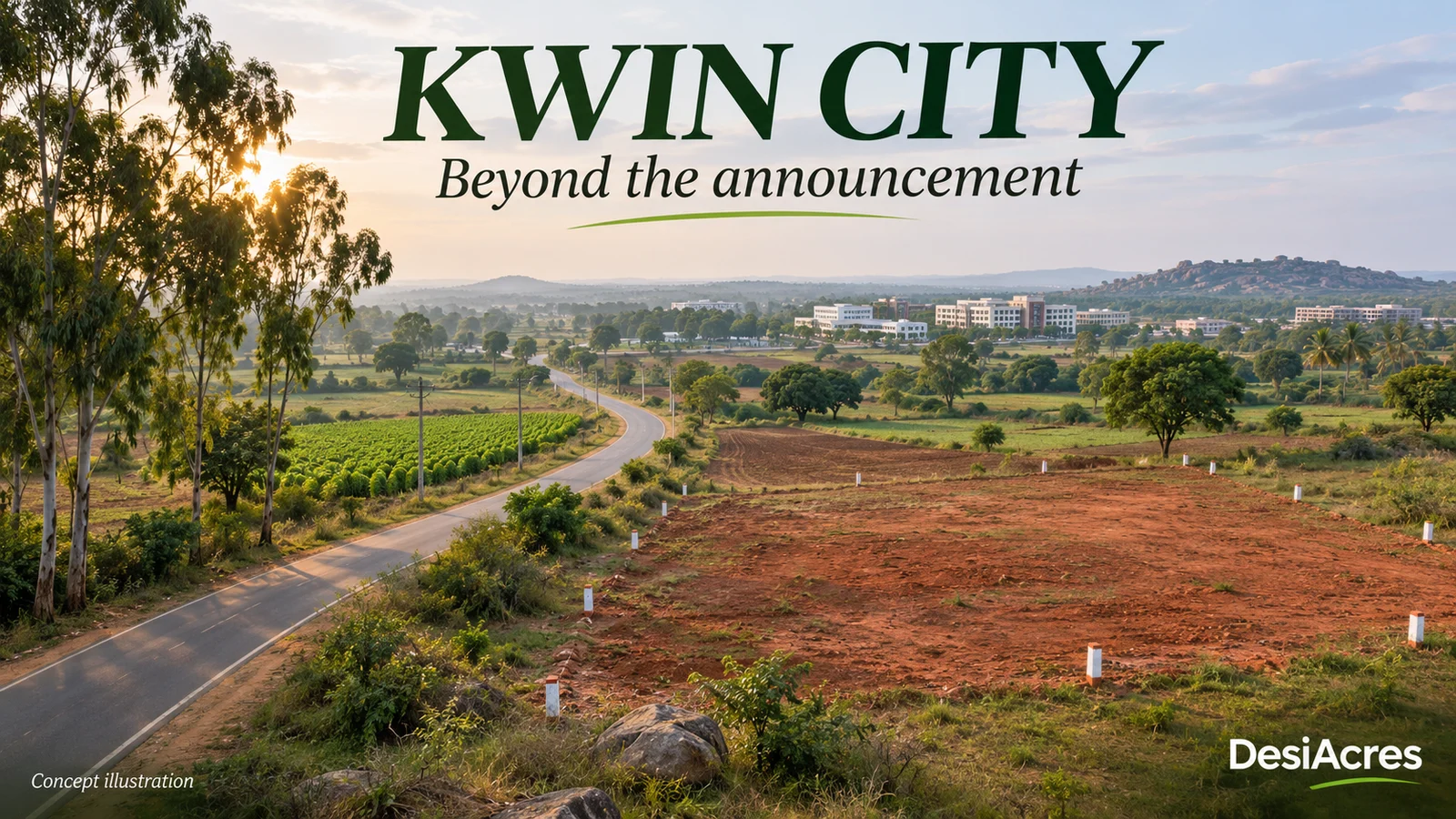
- "Near KWIN City" should start your investigation, not end it. Near which boundary, by which road, dependent on which future development?
- An announcement becomes demand in stages: agreements, land, infrastructure, construction, then people. Price the stage that is verified.
- Reports of the project's size differ. Use the latest official document before you put any acreage in a map or a headline.
- Land that takes longer to pay off costs more to hold. Test three holding periods and buy only if the slowest one still works.
Property in the north-west of Bengaluru is being described as "near KWIN City", and the phrase is starting to appear in listings, WhatsApp forwards and site banners. It is a good prompt to look closely at a place. It is a poor reason to pay a premium.
This guide is for someone considering land or a plot in that belt and wanting to know what to check. It does not predict prices, and it does not say the project will or will not succeed. It shows you how to separate what is verified from what is hoped for, and how to find out what a long wait would cost you.
What has been announced
KWIN City, short for a knowledge, wellness and innovation city, was publicly launched in Karnataka in September 2024, as reported in the press. Later reports described the state's interest in bringing institutions, including foreign universities, to the project. Those reports are useful for understanding intent. They are not completion certificates.
Start your reading on the state's own sites: the Industries Department and the industrial areas board, KIADB, publish notices about land and projects. Keep a note of the date next to every claim. A fact from 2024 may have changed.
Where your land sits
"Near" can mean three different things, and the price should differ for each.
- Inside the project boundary. The land may be subject to acquisition, reservation or special rules. Do not assume it can be sold or developed as ordinary land. Ask what the boundary notification says.
- On the edge or on a feeder road. Access and visibility may improve if infrastructure arrives. It may also be affected by road widening.
- In the wider corridor. The connection is an expectation. Treat it as a story until the stages below are met.
Draw your own map. Mark the project boundary only if you have an official source for it, and say which. Mark the nearest town, the access road you would use, and the plot. If you cannot draw the boundary, write "not yet sourced" on the map. That honesty protects you later.
The development stages
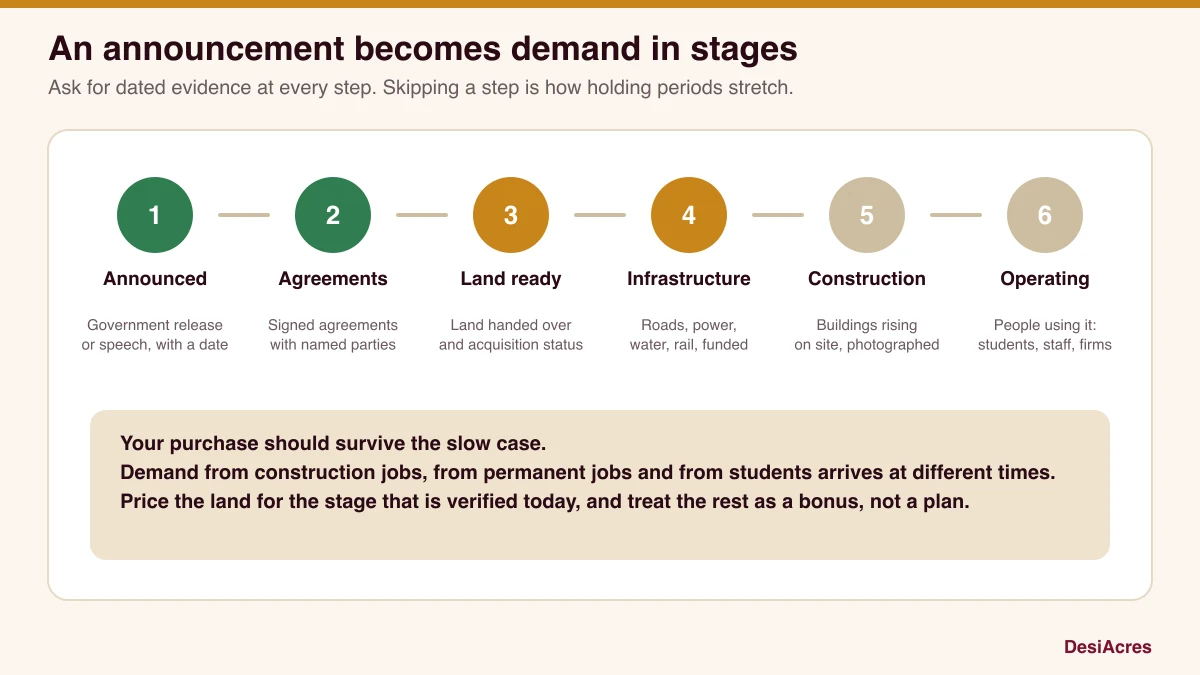
Do not read the ladder as a promise. Read it as a list of questions.
- 1Announced. Who announced it, when, and in what document?
- 2Agreements. Which institutions or companies have signed, with whom, and for what?
- 3Land ready. How much land is in the hands of the project, and how is the rest being handled?
- 4Infrastructure. Which roads, power, water and transport links are funded, awarded and started?
- 5Construction. Can you see buildings rising? Photograph them with a date.
- 6Operating. Are students, staff and firms actually there?
If you only have steps one and two, you are buying an expectation. That can still be reasonable at the right price. It is just a different bet from buying near a campus that is open.
How demand might arrive
Demand does not come all at once, and different people want different things.
- Construction demand. Workers and contractors arrive early and want rentals, not land.
- Permanent employment. Staff and families come later and want homes with schools and shops.
- Students. They want rooms and shared homes close to a campus, and only when it opens.
- Investors. They arrive at announcements and may leave with them.
Ask which of these is likely to want your land and when. A plot on a road with no water or power is not what a family buys. Be honest about who the future buyer is.
Access today
Visit the land. Drive the road you would use, at a busy hour and after rain. Note the width, the surface, the nearest bus stop and the distance to a town with a hospital and a school. Write down what exists today and what is only proposed. The two columns should never be mixed.
For a plot, the access question has a legal side as well. Our guide to road access for a plot explains how to check it.
Investigate the parcel itself
A growth story does not change what the land is. For the parcel you are considering, work through the usual list.
- Who owns it, and does the chain of title hold? Read the guide to matching the sale deed, RTC and EC.
- What is its recorded land use, and is conversion done or pending?
- Is any part of it likely to be touched by a road, a reservation or a project requirement?
- Is there a lake, a drain or a slope that changes what can be built? The drain and lake check covers this.
- Is the survey number clear, and does it match the land you walked?
The state's land records portal, Bhoomi, is where the revenue record of rights is published. Read it, but do not treat any one record as proof of title.
Price evidence
Separate three kinds of numbers.
| Kind of number | How reliable | How to use it |
|---|---|---|
| Asking price | A seller's hope | Starting point only |
| Registered sale price | What was actually paid | Strongest evidence, if recent and comparable |
| Independent valuation | An opinion with reasons | Useful if it shows its comparables |
Ask for recent registered sales of similar land nearby, with the extent, the road and the date. If there are none, that is information: it means the market is thin and you may find it hard to sell.
What waiting costs
Land does not pay you while you hold it. It costs you. Interest, taxes, upkeep, a fence and a watchman are real, and so is the money you could have earned elsewhere. Here is a simple, hypothetical way to think about it.
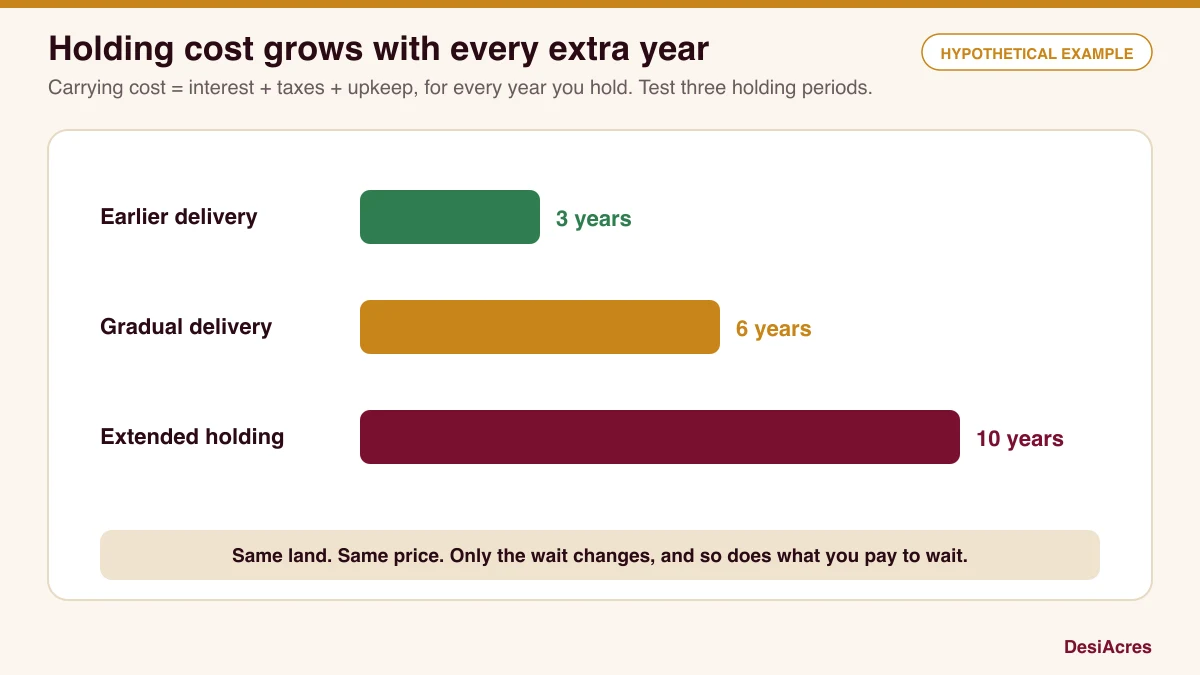
Work out your yearly carrying cost with your own numbers. Multiply it by three, six and ten. Then ask whether the land would still make sense if the long case were the real one. Do not assume a rate of price growth you cannot support. If your plan only works with a high growth rate, it is a hope.
The exit
Before you buy, picture who buys from you. A plot buyer wants clear papers and access. A developer wants a clear title, a road and a size that works. A farmer wants the land to be farmland. Find evidence that such buyers exist near this land today: recent sales, active developers, visible demand. If you cannot name your buyer, you cannot count on your exit.
Your decision summary
Fill in three lists before any token money moves.
- Verified: the boundary source, the stage of the project, the title chain, the road you drove.
- Conditional: the parts of the plan that need infrastructure or institutions to arrive.
- Open: every question you could not answer, and what answer would make you walk away.
If the open list is long, wait. Land will still be there.
Frequently asked questions
Is land near KWIN City a good investment?
That depends on the specific parcel, the price you pay and how long you can hold. This guide does not predict returns. It helps you check the parcel, the access, the stage of development and the holding cost so you can decide for yourself.
How do I know if a plot is inside the project boundary?
Ask for the official boundary notification and compare it with the survey number of the land. Do not rely on a banner or a map drawn by a seller. A lawyer and a licensed surveyor can confirm it.
What happens if the project takes longer than expected?
You keep paying to hold the land. That is why this guide asks you to test a long holding period and to buy only if the slow case still works.
Where do I check land records?
Karnataka's land records are on the Bhoomi portal. Read the record, then confirm it against the sale deed and a survey sketch. No single record is proof of title.
How DesiAcres can help
Use GeoVerify to screen a location for nearby lakes, drains and other mapped features, and explore the area on DesiPropVERSE. These are first checks to decide what to ask, and they do not replace a lawyer, a surveyor or a visit.
- Karnataka Industries Department (industries.karnataka.gov.in)
- KIADB, Karnataka Industrial Areas Development Board (kiadb.karnataka.gov.in)
- Bhoomi, Karnataka land records (landrecords.karnataka.gov.in)
- The New Indian Express, KWIN City launch, September 2024 (newindianexpress.com)
Written by DesiAcres Editorial at DesiAcres Advisory Group, a Bengaluru buyer-side property advisory. General information, not legal or investment advice.
Run it through the free 15-point check, price vs comparables, red flags and a clear verdict.
Check a property →