
Buying Near Bengaluru Metro Phase 3: Is the Seller's Metro Premium Justified?
A seller says the metro will lift the price. Here is how to measure the real walk to the station, the timeline risk, and how much of the price gap is actually metro.
DesiAcres Editorial · 19 November 2026 · 8 min read

- "Near the metro" is a claim to test. Ask near which alignment, which station entrance, and by which walking route.
- A metro line gets approved, funded, built and opened in stages. Price the stage that is verified today, not the opening ceremony.
- Never credit the whole price gap to the metro. Match age, size, floor and finish first. What is left over is the most the metro can be worth.
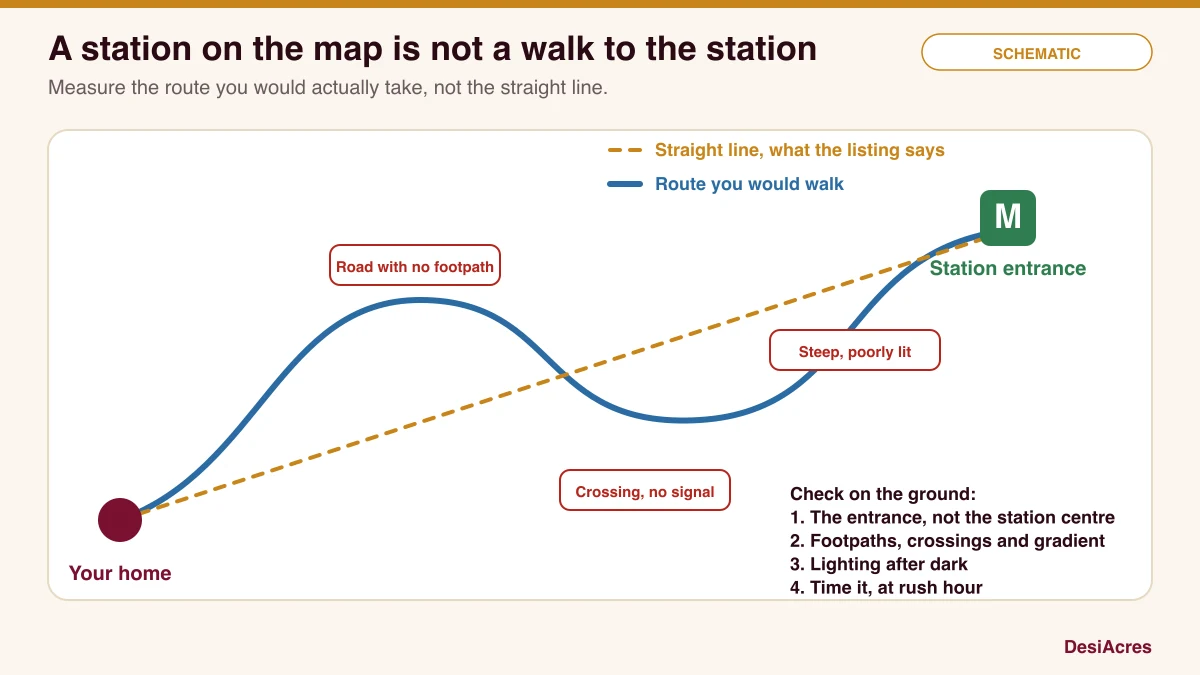
- Time the walk at rush hour, in the dark and in the rain. A station 600 m away on the map can be 1.4 km on foot.
A seller says the future metro station will transform this location, and the asking price already agrees. Before you accept that, you need three answers. Where is the station planned? How would you actually reach it? And how much of today's price is paying for connectivity that does not yet exist?
This guide is a method, not a prediction. It will not tell you where prices are going. It will tell you how to separate the part of a premium that is evidence from the part that is hope, so you can decide with your eyes open. If you want the background on the two corridors first, read our companion guide on what ORR West and Magadi Road mean for home buyers.
What has actually been approved
Bengaluru's Metro Phase 3 was approved by the Union Cabinet as a project of about 44.65 km with 31 stations, on two corridors: one along the Outer Ring Road on the west side, and one along Magadi Road. The Cabinet release is on the Press Information Bureau site. Japan's development agency JICA later published a financing announcement that mentions a completion target, which was reported as January 2032.
Read that sentence again as a buyer. "Approved" is a decision. "Financed" is money. A "target" is a hope with a date on it. None of the three is a train. When you quote a timeline to anyone, quote the source and the date of the source, and call it a target.
What "near the metro" really means
Listings use the phrase for very different things. Before you compare two homes, write down which of these each one means.
| Claim | What it usually measures | What you should ask |
|---|---|---|
| Near the alignment | Distance to the planned line, as a crow flies | Where exactly does the line run, and is it elevated or underground here? |
| Near the station | Distance to the middle of the station | Where is the entrance, and which side of the road is it on? |
| Walkable | A walking time quoted by the seller | By which route, at what pace, at what hour? |
| Connected | A feeder bus, auto or road link | Who runs it, and does it exist today? |
Only the third and fourth rows change your daily life. A home 400 m from an alignment can still be a 25-minute walk if a flyover, a nala or a gated campus sits between you and the entrance.
The last-mile investigation
This is the part sellers skip and buyers feel every day. On a weekday, walk from the home to where the station entrance is planned. If the entrance is not yet drawn, ask the metro company or read the project document and use the nearest planned location, and say so in your notes.
Check these on foot:
- Is there a continuous footpath, or do you walk on the carriageway for part of the way?
- Where do you cross the main road, and is there a signal, a zebra crossing or only luck?
- How steep are the gradients, and would a parent with a pram or an elderly relative manage them?
- Is the route lit at night, and does it pass through places you would not choose after dark?
- Are there service roads, drains or barriers that will be rebuilt during construction?
Then time it. Do it once at the busiest hour and once after dark. Write down the minutes, not an impression. A 20-minute walk is a feeder-bus decision in disguise.
Read the timeline in stages
A metro line is not a switch. It moves through stages and each one has its own evidence.
- 1Approval. A cabinet or board decision. Evidence: a government release with a date.
- 2Funding. A loan or budget commitment. Evidence: a lender or finance department announcement.
- 3Land. Acquiring or reserving land along the route. Evidence: notifications and the pace of possession.
- 4Contracts. Awarding civil and systems work. Evidence: tender and award notices.
- 5Construction. Pillars, viaducts, stations. Evidence: your own dated photographs.
- 6Operations. Passengers on trains. Evidence: the opening notice, and ridership afterwards.
Where is your station today? If you cannot name the stage, you are paying for stage six on the strength of stage one. That is the single most common way a premium outruns its evidence.
During construction, the street is a building site
Years before a station opens, the road outside it is a work zone. Expect barricades, diverted traffic, noise, dust and changed access for a long stretch. Frontage can change too: a service lane, a median or a pillar may move where your gate or your shop sign is. Ask the seller for the alignment and station drawings, and compare them with what you see.
Construction is not only a cost. Activity can also attract shops and services early. Just do not assume the benefit and the disruption cancel out. Treat them as two separate lines in your notes.
A premium calculation you can do in ten minutes
Here is a hypothetical example, used only to show the method. The figures are made up.
| Item | Amount |
| A comparable home with no connectivity claim | ₹1.20 crore |
| A home marketed on the future metro | ₹1.35 crore |
| Gap | ₹15 lakh, or 12.5% |
The seller will say the gap is the metro. Do not accept that. First make the two homes comparable, then see what is left.
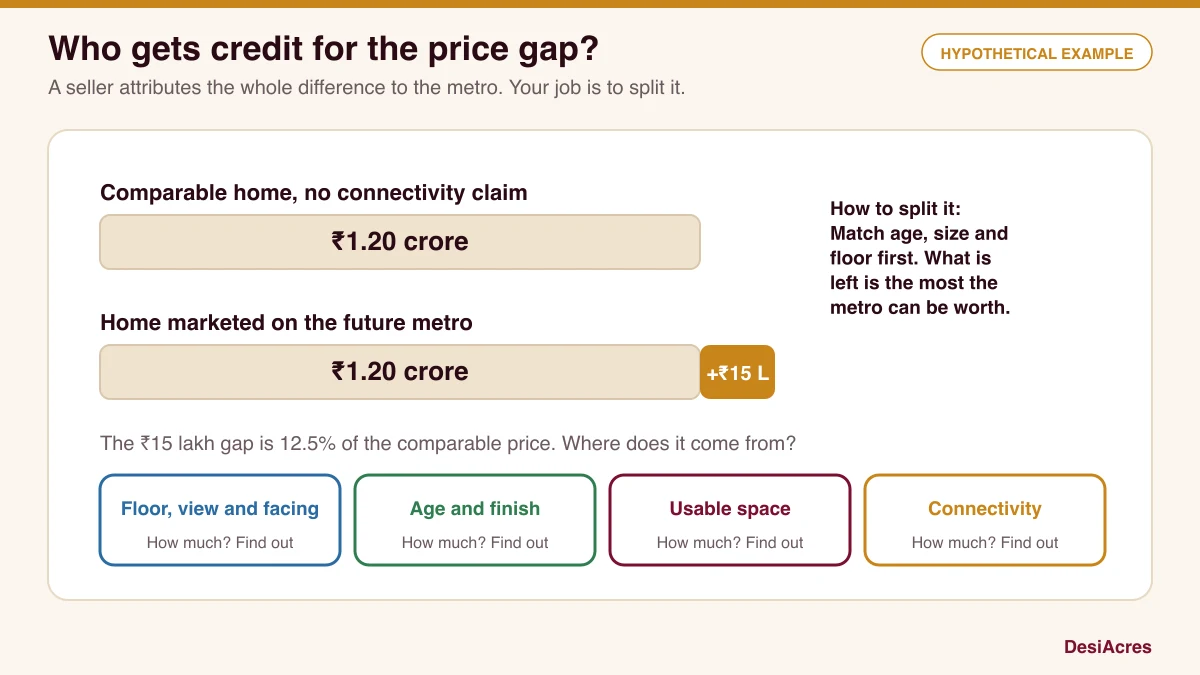
- 1Match the age of the building, the carpet area, the number of bedrooms and the floor band.
- 2Adjust for the floor, the view and the facing. A park-facing eighth floor is not a first floor on a busy road.
- 3Adjust for finish, parking, amenities and maintenance charges.
- 4Whatever gap remains is the most the metro can be worth in the market today. It may be smaller than you were told, or zero.
For real numbers, use registered sale prices and actual listings for similar homes in the same micro-market, not asking prices alone. Our area explorer shows listed rates around a location, which is a place to start, not an end.
Questions for the seller
- Which station, which entrance, and how far is it by the route I would walk?
- Which stage is this section of the line in, and where did you read that?
- What will the road outside the property look like during construction?
- Has anything on the alignment drawing changed since you bought or listed?
- Can I see recent sale prices for comparable homes without the metro claim?
A good seller answers with dates and documents. A seller who answers with enthusiasm has told you what you needed to know.
The property checks do not go away
A station nearby fixes none of the usual risks. Title, approvals, drainage, access and builder track record are separate checks, and a premium location with a weak paper trail is worse than an ordinary one with a clean file. Run the location screen on DesiAcres GeoVerify and read the guide to the lake and drain checks before you pay a token.
What to decide
Write down three lines before you commit.
- Verified today: the stage the line is in, with sources, and the walk you measured.
- Conditional: the parts of the premium that depend on later stages.
- Unresolved: what you could not confirm, and what would change your mind.
If you would still buy at today's price with the conditional part at zero, the metro is a bonus. If you would only buy because of it, you are betting on a timeline. That bet may pay off. Make it knowingly.
Frequently asked questions
Does a metro station always raise nearby property prices?
No. Connectivity can support demand, but it is one factor among many, and the effect depends on the station's access, the local supply and the stage of the project. Treat any premium as a claim to test with comparable sales.
How far from a station counts as walkable?
There is no single number. Measure the real route and the time it takes at the hours you would travel, and consider footpaths, crossings, gradients and lighting. A short straight-line distance can hide a long, unpleasant walk.
Should I buy before the line opens?
That depends on the price you pay and how long you can wait. If today's price already includes the opening, you are paying in advance for a result that is not yet certain. Price for the stage that is verified, and hold enough margin for delays.
Where can I check the official project details?
Start with the government and agency sources listed at the top of this guide, and read the project documents on the metro company's site. Quote the date of each source.
How DesiAcres can help
Look up the location on DesiPropVERSE for nearby projects and listed rates, and check the screen on GeoVerify before you accept a connectivity premium. Our checks do not replace a lawyer or a site visit. They tell you what to ask next.
- PIB, Cabinet approval of Bengaluru Metro Phase 3 (pib.gov.in)
- JICA, financing announcement for Bengaluru Metro Phase 3 (jica.go.jp)
- BMRCL, Phase 3 project document (phase3laq.bmrc.co.in)
- DesiAcres, Namma Metro Phase 3 and what it means for buyers (desiacres.com)
Written by DesiAcres Editorial at DesiAcres Advisory Group, a Bengaluru buyer-side property advisory. General information, not legal or investment advice.
Run it through the free 15-point check, price vs comparables, red flags and a clear verdict.
Check a property →