
How to Read a Karnataka RERA Project File: Dates, Approvals, Progress and Questions to Ask
A registration number is where checking starts. Match the phase, read the dates, compare filings with the site, and turn gaps into questions for the builder.
DesiAcres Editorial · 19 November 2026 · 7 min read
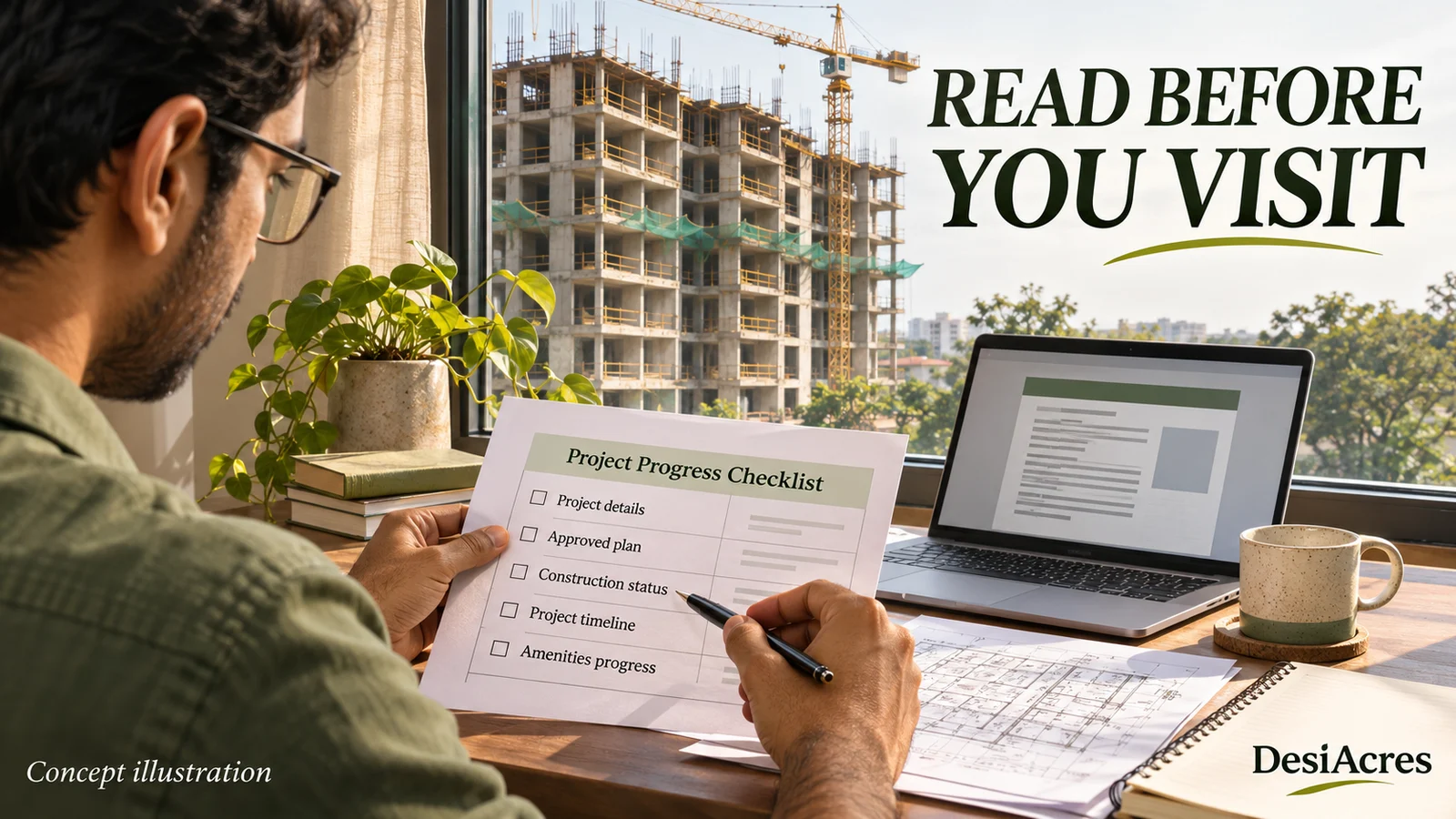
- A registration number is the start. Check that the phase, promoter and location on the page match the home you are being offered.
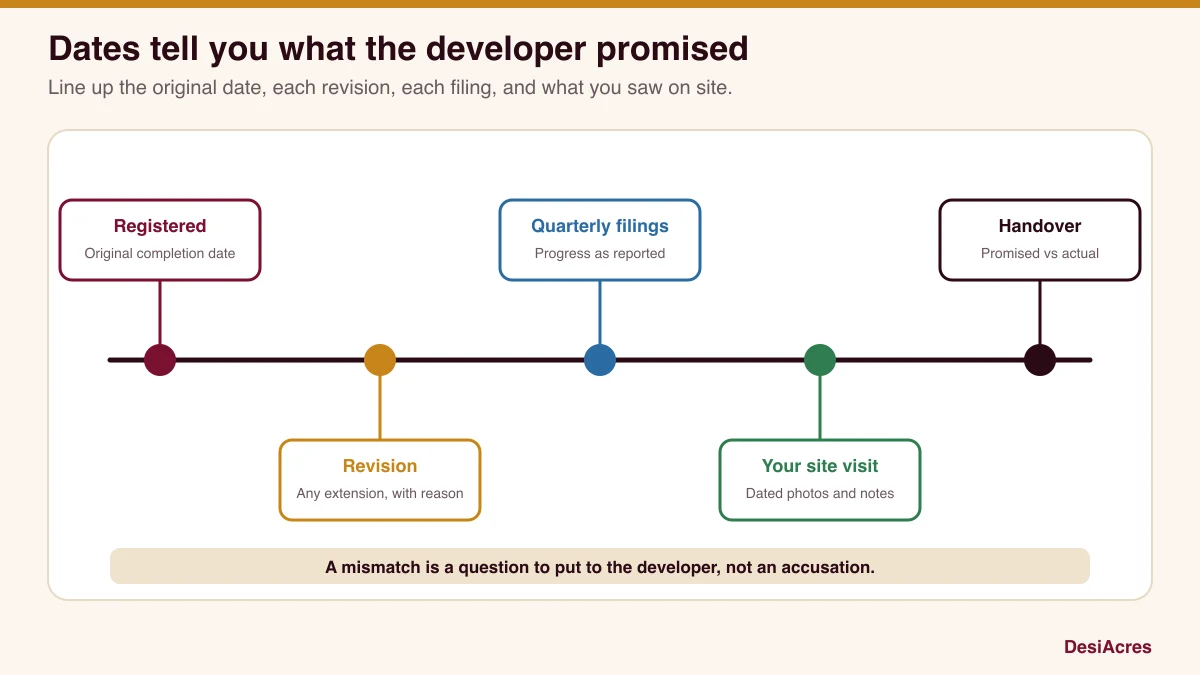
- Line up the original date, every revision, each filing and your own dated site photographs. Mismatches become questions.
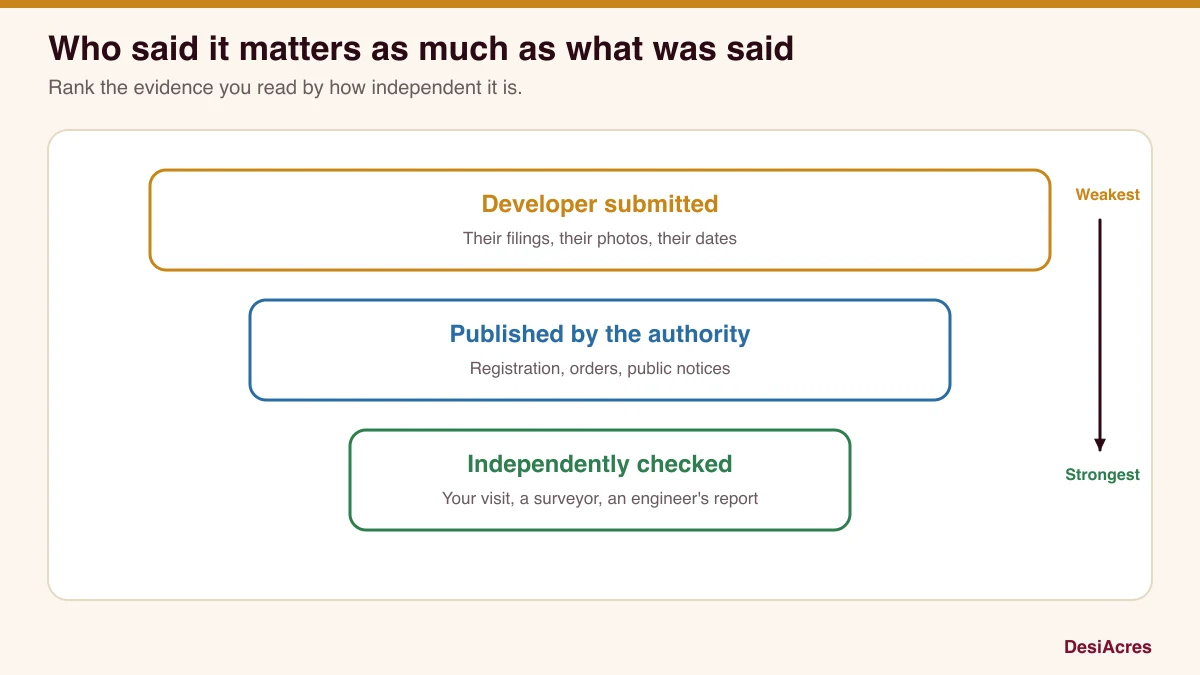
- What the developer submitted, what the authority published and what you verified yourself are three different strengths of evidence.
- Missing information should trigger a follow-up question, not an accusation.
A registration number on a brochure is the beginning of the check. The more useful question is whether the phase, the documents, the reported progress and the dates on the file match the specific home being offered to you.
This guide shows how to turn a project page into an evidence sheet you can carry to a site visit. It builds on our shorter walkthrough, how to read a K-RERA project page in 10 minutes, and goes further into dates, filings and how to ask. It is general information, not legal advice. State rules and forms change, so confirm on the authority's site.
Find the exact registration
Developers often hold several registrations, one for each phase or tower. A project name is not enough. Get the registration number for the specific phase you are buying into, ask the seller to show you where it appears on the authority's portal, and open it yourself.
Check that:
- the promoter's name matches the company on your cost sheet and draft agreement;
- the project location, survey numbers and boundaries match the land the seller described;
- the unit type, tower and floor you are being offered fall within the registered phase.
If the registration covers phase one and you are buying in phase three, you are not looking at the right file.
Read the dates
Every project file has dates. Put them in one place.
- The date the project was registered.
- The original promised completion date.
- Any revised date and the stated reason.
- The date of each progress filing.
- The date the agreement for sale will promise possession.
Under the Act, a promoter must declare a time period for completion, and delays can lead to interest payable to the buyer. That makes the date you are promised in your agreement important, and it should not be later or vaguer than the one on the authority's file without a clear reason.
Find the progress filings
The Act and the state rules require promoters to update progress. Frequency and format are set by the state, and in many cases it is quarterly, so check the current requirement on the authority's website. Look for the filings on the project page and read the latest one.
For each filing, record the period, the percentage or description of work completed, the number of units sold, and any change since the last one. Compare them. Does progress rise steadily, or does it jump or stall? Do the sold units match what the sales team told you?
Examine approvals and documents
The file typically includes uploaded documents. Open the ones that matter.
- The sanctioned or approved building plan, and its date and validity.
- The commencement certificate, where applicable.
- Environmental or fire clearances, where required for the size of project.
- Land title declarations and affidavits submitted by the promoter.
- Certificates from the architect, engineer and chartered accountant.
You are not expected to read every drawing. You are checking that the documents exist, are current, and name the same land and project. Note anything missing or expired. Our guide to matching the deed, RTC and EC with the site covers the land side in more depth.
Compare the file with the site
The filing says one thing and the building may say another. Visit, with permission, and photograph with the date visible. Compare with the latest filing.
- Which floors have slabs cast, and how many floors does the filing say?
- Are walls, plastering or finishes visible at the stage described?
- Is work happening, with workers and materials on site, or is the site quiet?
- Are amenities started, and do they match the promised layout?
Take the same shots again on a later visit. A series of dated photographs shows the pace better than one visit.
Who said it matters
A progress figure submitted by the promoter is the promoter's statement. It is useful, and it is also the thing you want to test. Something the authority has published, such as a registration or an order, carries more weight. Something you or an independent engineer have checked carries the most for your decision.
Label each line in your notes with its level. Where all your evidence is the developer's own, you have not yet verified anything.
Extensions, orders and complaints
Look for any revision of the completion date, and read the reason given. Search the authority's site for orders or complaints naming the promoter or the project. An extension is not automatically a bad sign: delays happen for many reasons, and the Act allows for some. What matters is whether the explanation is specific and whether the new date is credible given the progress.
Record what is missing
If a field is blank, a document is missing, or a filing is old, write it down without drawing a conclusion. Missing information is a question for the developer. A reasonable promoter will respond, upload or explain. A promoter who will not tell you is also telling you something.
Build a project evidence sheet
Make a one-page sheet you bring to every visit.
| Field checked | Source and date | What it says | Question to ask |
|---|---|---|---|
| Registered phase | Authority page, today's date | Phase and tower | Does this match my unit? |
| Original completion date | Registration | The date promised | Why did it move? |
| Latest progress filing | Authority page | Period and percentage | How does it match the site? |
| Approvals | Uploaded documents | Plan, certificates | Are they current? |
| Site observation | Your photos, dated | What you saw | What explains the gap? |
Fill one row for each thing you check. Keep the sheet with your quotation and draft agreement.
Turn findings into questions
Specific questions get specific answers. Compare:
- Weak: "Is the project on time?"
- Strong: "The registration shows possession in a given month, the latest filing shows work at a given stage, and my visit last week showed slabs up to a given floor. How do you expect to meet the promised date?"
Write three or four strong questions before you meet the sales team, and ask them in writing. The reply is part of your record.
What RERA does not do
RERA registration is a protection and a source of information. It is not a guarantee of quality, delivery or title. It does not replace a lawyer's opinion on title or an engineer's view on construction. Use it as one layer, with the others.
Frequently asked questions
Is a RERA registration enough to trust a project?
No. It shows the project is registered and provides information to check. You still need to verify the land title, the approvals, the construction progress and the builder's track record.
How often do promoters update progress?
The state rules set the schedule, and it is commonly quarterly. Check the authority's website for the current requirement and the dates of the latest filings.
What should I do if the file does not match the site?
Write down the specific differences with dates and photographs, and ask the developer in writing to explain. Keep the reply. If the answer is poor, consider waiting or choosing another project.
Where do I find the official rules?
On the state authority's portal and in the Real Estate (Regulation and Development) Act, 2016. Rules and forms change, so use the current versions.
How DesiAcres can help
Use the evidence sheet, and bring it to us if you want a second pair of eyes. We can help you decide what to ask before your next site visit, and screen the location on GeoVerify. Our work is a checking aid, and we do not give legal advice.
- Karnataka RERA, official portal (rera.karnataka.gov.in)
- Real Estate (Regulation and Development) Act, 2016 (indiacode.nic.in)
- DesiAcres, How to read a K-RERA project page in 10 minutes (desiacres.com)
Written by DesiAcres Editorial at DesiAcres Advisory Group, a Bengaluru buyer-side property advisory. General information, not legal or investment advice.
Run it through the free 15-point check, price vs comparables, red flags and a clear verdict.
Check a property →